Laying out a slab: stakes, string line, and when a laser earns its keep
Layout is the cheapest place on a job to be accurate and the most expensive place to be wrong.
September 15, 2026 · 4 min read
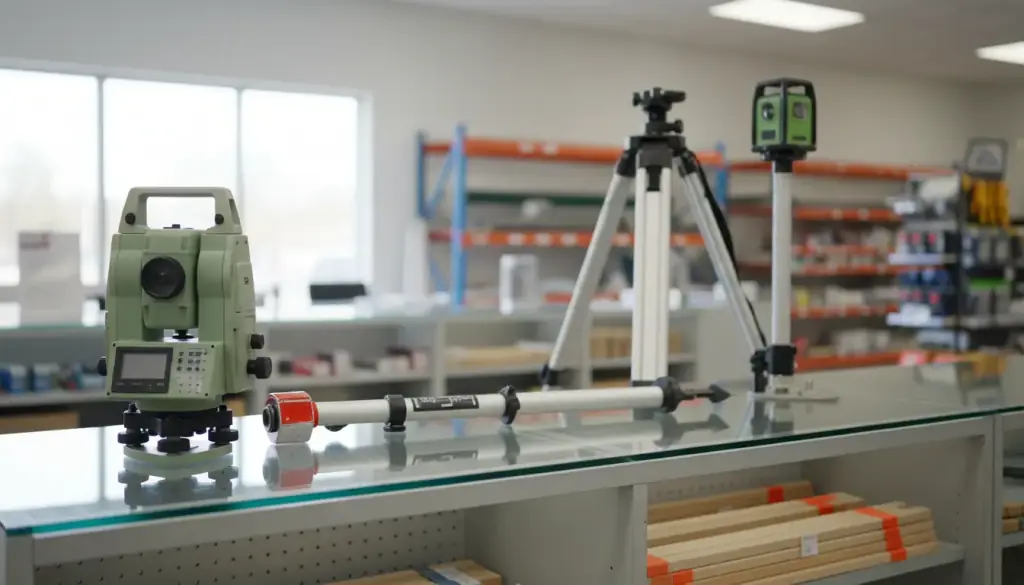
Nothing later in a job can fix a bad layout. Formwork built to the wrong line is square, level and in the wrong place, and the concrete that goes into it is permanent. That is why layout gear is worth the small amount it costs relative to everything downstream of it, and why the consumables move off our shelf faster than almost anything else we carry.
Consumables first
Hub, grade and lathe stakes are the backbone. Hubs go in and stay, grade stakes carry the marks, and lathe gives you something tall enough to see from across a site. Stake whiskers and blue tops make a stake findable in long grass or after a scrape, which matters more than it sounds like it should when a crew is looking for a point at seven in the morning.
Wire flagging and engineer flagging ribbon do the same job at different scales. Wire flags mark utilities and small points on the ground. Ribbon marks anything you need seen from a distance or tied to something vertical. Upside down marking paint is made to be used from standing height with the can inverted, which is both faster and straighter than bending over a normal can, and lime and chalk cover the cases where paint is too permanent.
- Hub, grade and lathe stakes
- Stake whiskers and blue tops
- Wire flagging and engineer flagging ribbon
- Upside down marking paint, lime and chalk
- String line, measuring tapes, measuring wheels and digital distance measures
Where string line stops being enough
String and a good tape will lay out a small rectangular slab accurately, and there is no reason to make that harder than it is. String starts to cost you when the distances get long enough for sag to matter, when the shape is not rectangular, or when elevation is the thing you are controlling rather than position. A string line tells you where. It is poor at telling you how high.
That is where an optical leveling instrument or a self leveling laser level starts paying. A rotary laser with a magnetically mounted receiver on a grade rod lets one person set grade across a whole pad and gives a consistent reference all day rather than a chain of measurements that each add a small error. On a pad of any size that is the difference between a slab that drains and a slab with a puddle in it.
Theodolites and angles
Digital theodolites earn their place when angles matter: setting a building corner, turning a known angle off a control line, or checking that a long wall is where the drawing says. For most flatwork you will not need one. For layout on a structure, it is the tool that keeps small angular errors from becoming large positional ones at the far end of the building.
Grade rods and story poles are the low technology version of the same discipline, and they are still the fastest way to repeat a known dimension without re-reading a tape every time. Plumb bobs have not been improved on for transferring a point vertically in still air.
A working order of operations
Set and protect your control points first, with hubs and whiskers, and do not let them get buried by the scrape. Mark the lines you need next, using paint for what should last and chalk or lime for what should not. Establish your elevation reference before anyone starts moving dirt, and check it again after they stop. Then build.
Look after the instruments
An optical level or a laser that has been knocked off calibration will give you confident, consistent, wrong numbers all day, which is more dangerous than an instrument that obviously does not work. Check a laser against a known point at the start of a job rather than trusting the self levelling indicator, and check it again if it has been in the back of a truck over rough ground.
Tripods matter more than they get credit for. A instrument is only as stable as the legs under it, and a tripod with a loose leg clamp will drift slowly through the morning while everyone assumes the readings are good. Set the legs firmly into the ground, keep them out of the traffic path if you can, and re-check the reference after anyone has walked near it.
Pocket laser layout tools have their place for interior work and short runs, and they are far quicker than setting up a full instrument for a job that only needs one line held for ten minutes. They are not a substitute for a rotary laser on a pad, and the usual mistake is stretching one past the range where it is actually accurate.
Stocked at the counter
We carry both ends of layout: the consumables that go in the ground on day one, and the instruments that put them there. Spectra Precision and DeWalt cordless lasers, optical leveling instruments, digital theodolites, self leveling laser levels, magnetically mounted receivers, tripods, grade rods and story poles, plus the stakes, flagging, paint and string that go with them. If you are choosing between an optical level and a laser for the work you do, call the counter at 20 NE 30th Street and we will talk it through.
Contractors Supply Co, (405) 525-7431
Call (405) 525-7431More articles
Rebar supports: getting the steel to the right height, and keeping it there
The cheapest way to ruin a slab is to let the steel end up on the ground.
Weeps, flashing and mortar nets: why a masonry wall stays dry
A brick wall is not waterproof. It is designed to let water back out, and that only works if the detail is right.